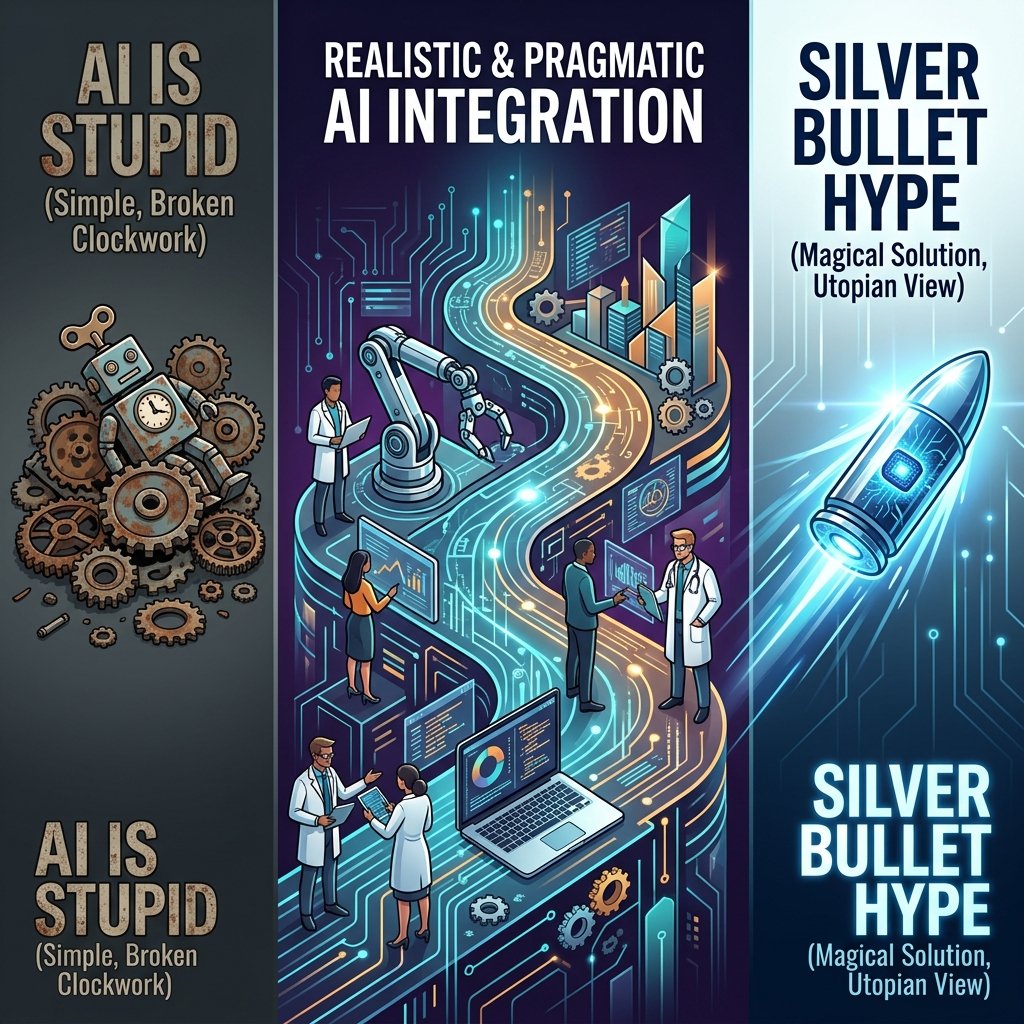
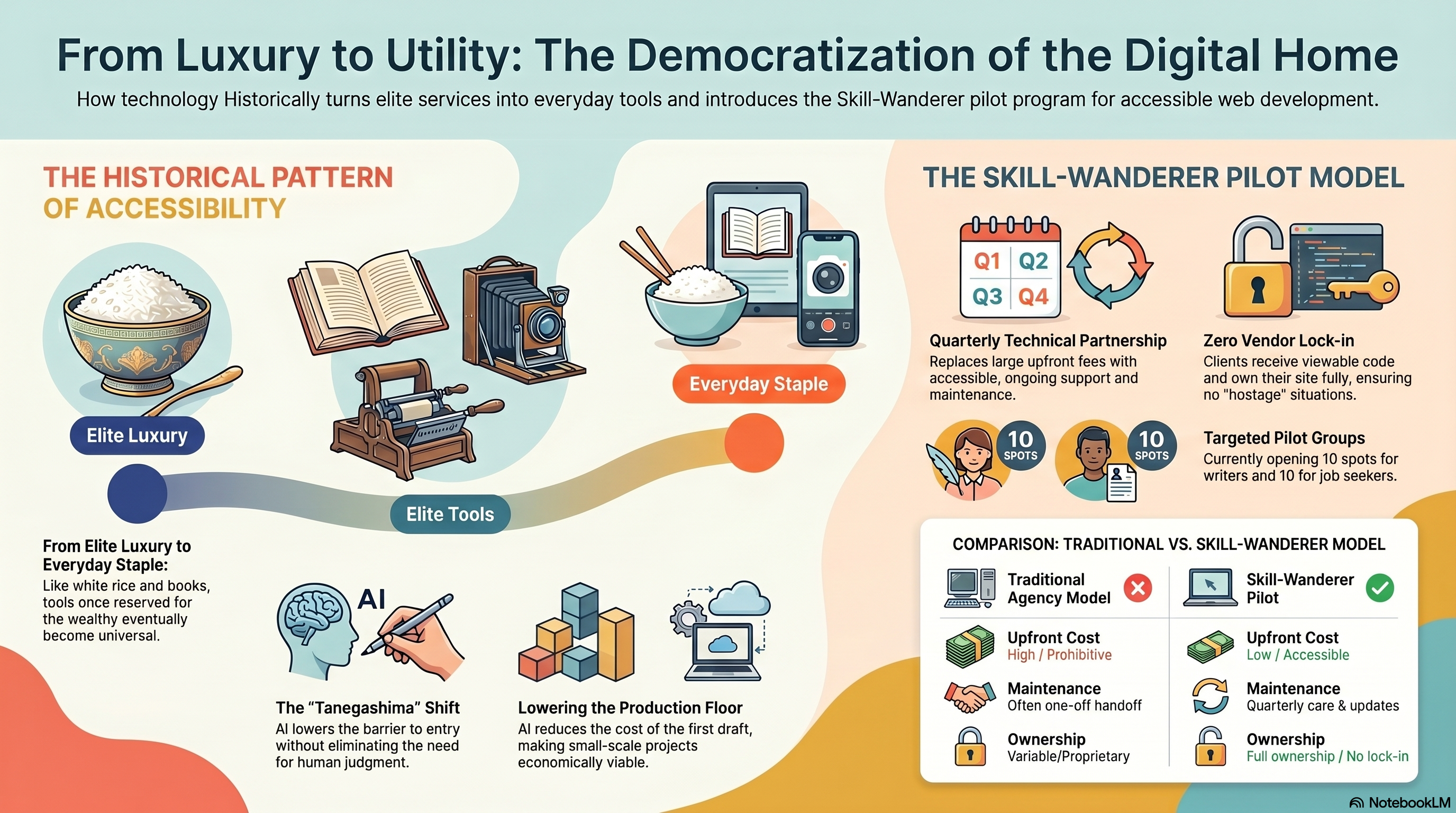
📊 Visual Summary: Want a quick overview? Check out our White Rice to Websites infographic that walks through the historical pattern, the connection to the Tanegashima essay, and what the Skill-Wanderer pilot offers.
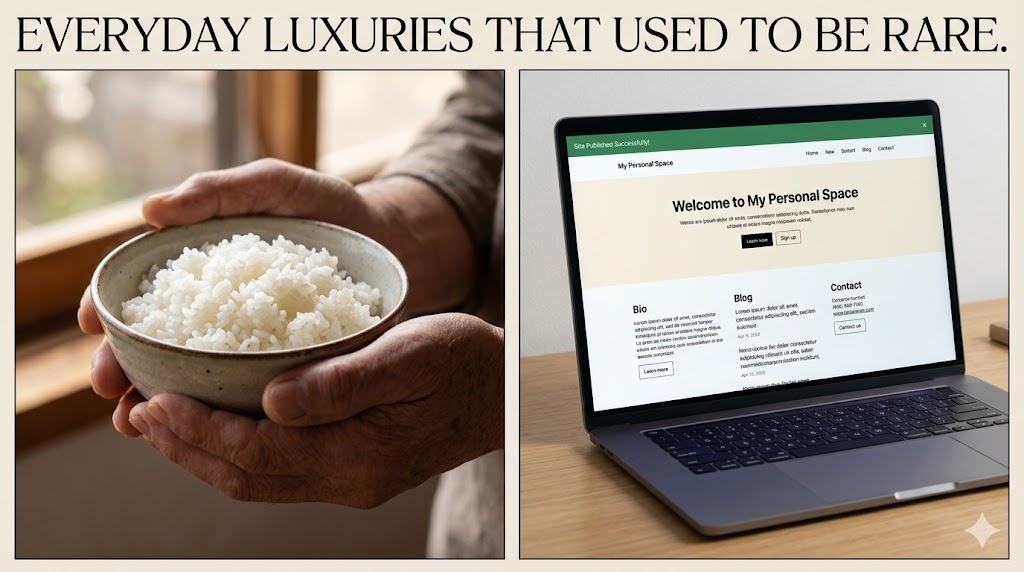
Watch the Video Version or Listen to the Podcast: If you prefer video content, here’s the complete video version of this post:
Or if you prefer audio format, you can listen to the podcast version on Spotify:
📑 Slide Version: Prefer a slide deck? View the presentation below or download the PDF.
🖼️ Infographic: Get a visual overview of the historical pattern, the connection to the Tanegashima essay, and the Skill-Wanderer pilot:
I. A Bowl of White Rice Used to Be a Luxury
For much of history, polished white rice was not ordinary food. It required extra labor, extra processing, and often belonged more easily on the tables of the wealthy than in the bowls of common households.
Hulling rice by hand is slow. Polishing it — removing the bran to leave that clean, soft, white grain — is even slower. For long stretches of time, that extra labor cost meant white rice was more often associated with nobles, samurai stipends, imperial courts, and wealthy merchants than with everyday families. Many households leaned on brown rice, mixed grain, millet, or whatever the harvest allowed.
Over time, better milling tools, industrial processing, transport, and local infrastructure changed the economics. Within a few generations, the thing that had once signaled status became one of the cheapest carbohydrates on the shelf. White rice did not stop being valuable. It stopped being scarce.
This is not a story about rice. It is a story about a pattern.
II. The Pattern Repeats
Look closely at the last six hundred years and you keep seeing the same shape:
- Books. Before Gutenberg, a single Bible could cost the equivalent of a house. Monks copied manuscripts by hand. After movable type, books became something a middle-class merchant could own, then something a schoolchild could own, then something you could pick up for free at a library.
- Photography. A portrait used to mean sitting for a painter for weeks. Then a daguerreotype studio. Then a Kodak Brownie. Then a cameraphone in three billion pockets.
- Publishing. A magazine used to require a printing press, distribution deals, and a staff. Then desktop publishing turned a Mac and a laser printer into a newsroom. Then blogs turned anyone with a modem into a publisher. Then social platforms turned anyone with a phone into one.
- Design tools. Typesetting was a guild craft. Then PageMaker. Then Photoshop. Then Canva, where a small business owner with no training can make a serviceable poster in twenty minutes.
- Software. Building software used to mean a mainframe and a team. Then a PC and a compiler. Then open-source frameworks. Then cloud platforms. Then SaaS. Each step lowered the floor.
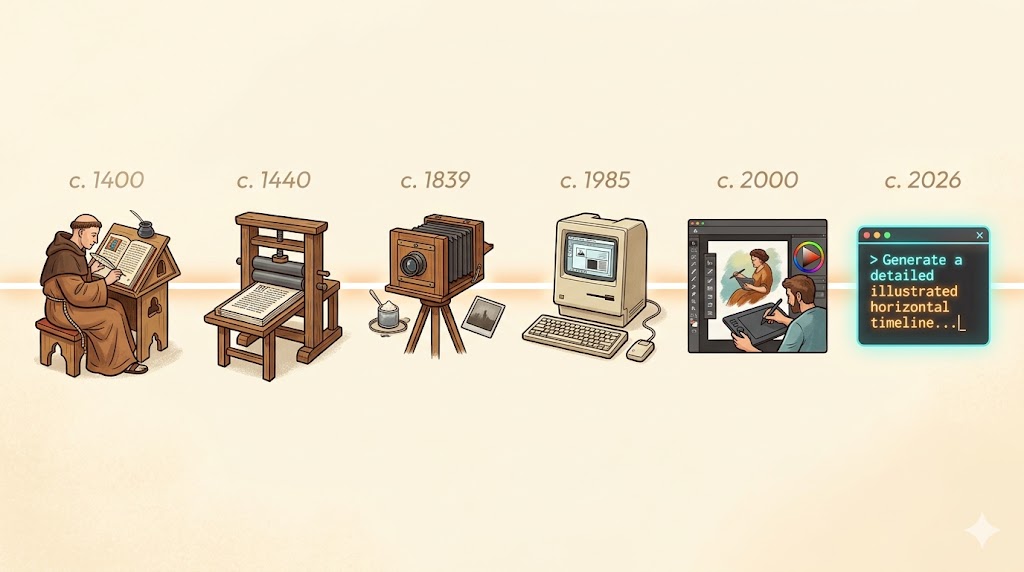
In each case, something the elite paid dearly for became something ordinary people could use without ceremony. The craft did not disappear. The artisan baker, the gallery photographer, the literary publisher, the senior engineer — they all still exist, and the best of them still command real money. But the baseline moved. The thing that used to be a privilege became a tool.
I think websites and basic software services are next.
III. The Tanegashima Was the Warning Shot
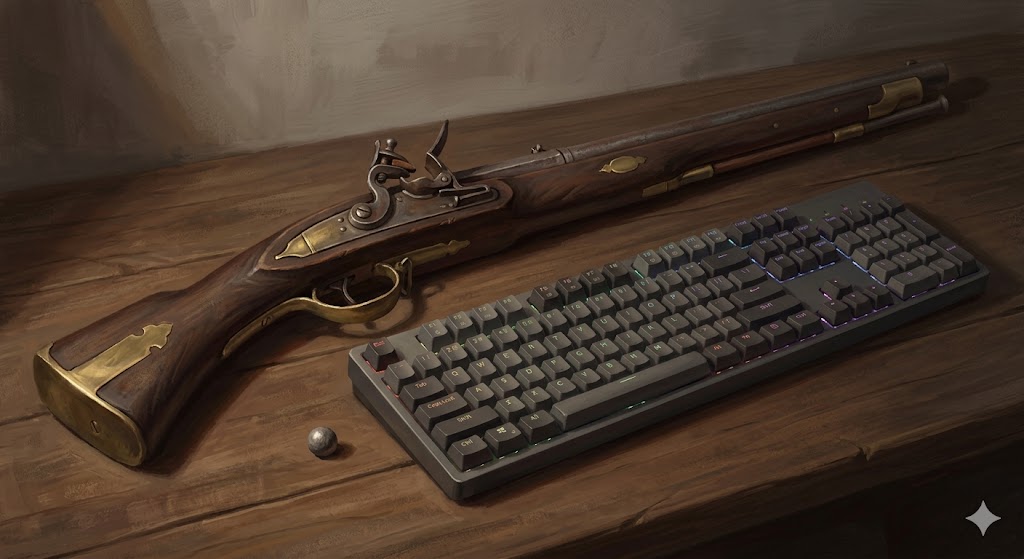
A few months ago, I wrote The Tanegashima Shift: The Tragedy and the Ascension of the Samurai Coder. That piece compared AI-assisted coding to the arrival of firearms in 16th-century Japan. The musket did not eliminate the need for tactics, terrain, or discipline. But it did lower the barrier to battlefield power so dramatically that the social order built around the sword could not survive it.
This essay is the economic and social sequel.
The Tanegashima piece was about the practitioner — what AI does to the developer’s craft and identity. This one is about the market — what AI does to the price, accessibility, and social meaning of the things developers build.
Because here is the part that matters: AI does not remove the need for engineering judgment. It changes who can build, how fast they can build, and what becomes economically possible to build at all.
IV. Why the Old Model Made Sense (For a Long Time)
For most of the web’s history, hiring someone to build you a website was genuinely expensive — and rightly so.
A serviceable site meant design mockups, frontend work, backend work, content modeling, hosting, deployment, security, accessibility, SEO, and a maintenance plan. A freelancer or agency was absorbing a lot of risk on your behalf: scope creep, browser compatibility, edge cases, and the fact that any single bug could eat a week.
The freelance and agency model fit that reality. You paid a meaningful sum up front because the production cost was a meaningful sum. The work was labor-intensive, the labor was specialized, and the specialization was earned through years of practice. That was a fair trade.
I want to be careful here. I am not attacking that model. The old model was not wrong. It was shaped by the cost structure of its time. Many of the best craftspeople I know still operate inside it, and for complex projects — a real product, a real platform, a real business with real traffic — it remains the right call.
But “everyone needs the same thing the enterprise needs” was never quite true.
V. What AI Actually Changes (And What It Does Not)
Here is what I have observed in the last year of building with AI-assisted tooling, both at Skill-Wanderer and on client work:
What it changes:
- For the right kind of simple landing page, work that once took days can sometimes be drafted in an afternoon. Not every project, not every time — but often enough to matter.
- The cost of a first draft drops sharply. You can prototype, throw it away, and prototype again without flinching.
- Small operators can take on shapes of work that used to require a team.
What it does not change:
- You still need someone who can decide what to build and why.
- You still need architecture choices that will not collapse at the second feature.
- You still need someone who understands deployment, domains, email, analytics, and the long tail of “it broke at 2am.”
- You still need to maintain the thing after launch — content updates, security patches, new browser quirks.
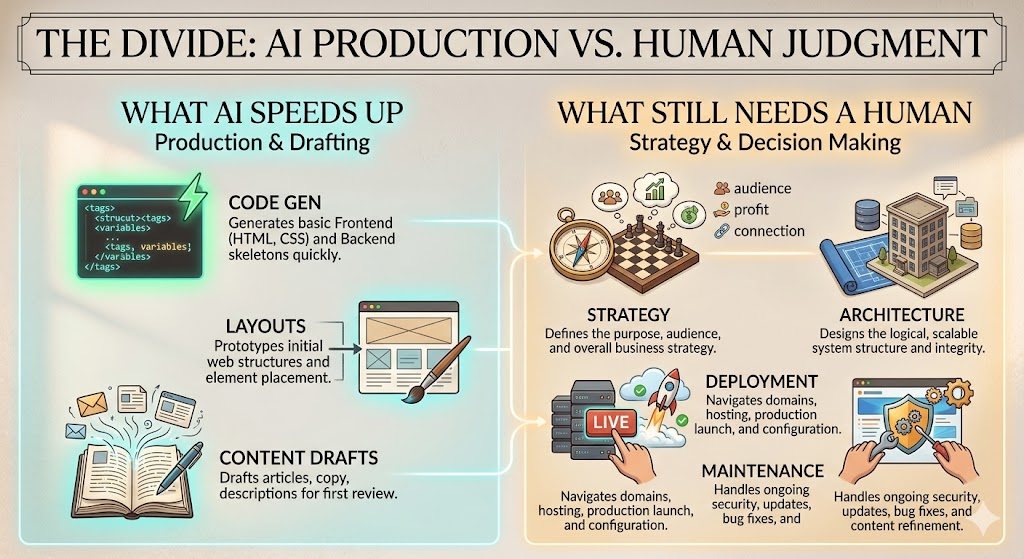
In other words: the craft is not gone. The production cost of the baseline has dropped. Those are very different statements, and conflating them is how both hype and despair get manufactured.
VI. Why the Old Model May Not Fit the People I Want to Serve
Now think about who actually needs a website.
A novelist who wants a clean home for their books and an email list. A graduate looking for a first job who wants something better than a LinkedIn URL. A coach, a translator, a small consultancy, a craftsperson who sells at three local markets a year.
For these people, the traditional model was always slightly miscalibrated. A four-thousand-dollar upfront project is a real decision for a working writer. The risk feels enormous because the outcome is uncertain. So most of them never start. They make do with a bio link, a half-finished Squarespace, or nothing at all.
That is the gap I keep returning to. Not “people who would have hired an agency anyway.” The much larger group: people who needed a clearer online home and quietly decided they could not afford to want one.
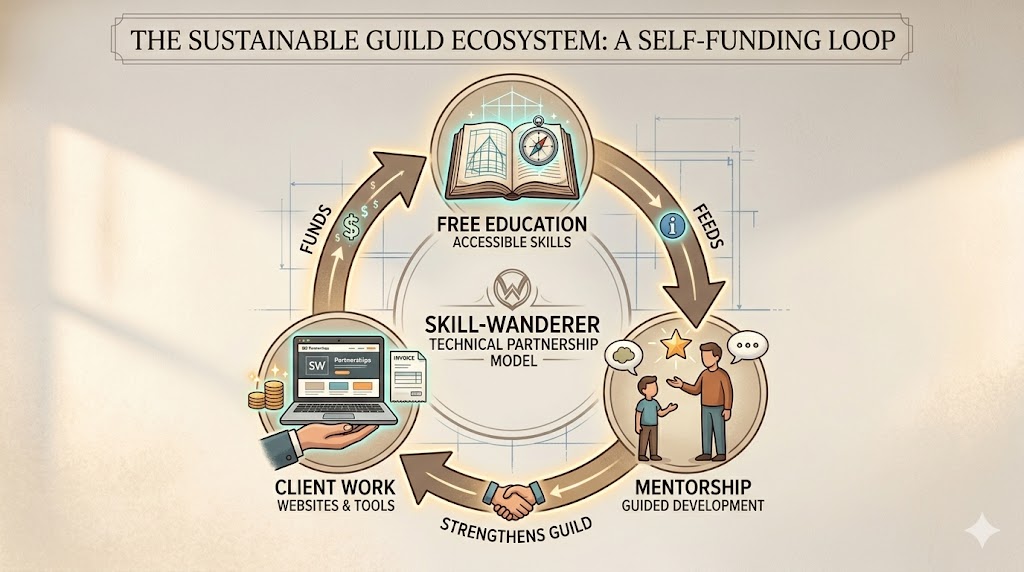
VII. Skill-Wanderer’s Technical Partnership Model
Skill-Wanderer started as an education project. The mission has always been to make serious technology skills accessible to people who were told, quietly or loudly, that those skills were not for them.
The technical partnership model is an extension of that mission, not a pivot away from it.
Here is the shape:
- Client work — websites, small tools, simple internal apps — funds the free education and mentorship side of Skill-Wanderer.
- Because we use AI-assisted development as part of the production stack, we can take on smaller-scoped work without the economics breaking.
- Because we are trying to operate as a guild rather than only a billable-hours agency, we can share risk differently. We can sit beside a client on a quarterly cadence rather than handing them a finished artifact and disappearing.
This is not a magic trick. It is just a different cost structure aimed at a different segment.
VIII. The Pilot
I want to be honest that this is an experiment, not a finished product line.
For our first cohort, we are testing a quarterly-paid website model with two specific groups: writers and job seekers. We are taking the first 10 clients in each segment as pilot partners.
A website should not become a hostage situation. If a client stays with us, it should be because the partnership continues to create value — not because leaving is painful, confusing, or technically impossible.
Pilot partners get:
- A real, owned, indexable website — not a hosted profile someone else controls.
- Viewable code and no vendor lock-in. Skill-Wanderer is not trying to trap clients. If the partnership no longer fits, the client should be able to leave with clarity instead of being locked inside a black box.
- A quarterly working relationship rather than a one-shot hand-off, so the site can grow with the person behind it.
- Ongoing care. Many small websites slowly decay after launch: copyright years stay stuck in the past, forms stop working, links break, plugins age, pages become outdated, and the original developer disappears. Our model is designed to stay beside the partner, keep the site working, and improve it quarter by quarter.
- Direct input into how this model evolves, because pilot partners will help shape it with us.
In exchange, we get something we could not buy: honest signal from real people on whether this actually serves them.
During the pilot, the pricing will be intentionally accessible — not because the work has no value, but because the point of the experiment is to lower the barrier for writers and job seekers who need a clearer online home but cannot justify a large upfront website project.
I am deliberately keeping the exact number out of this essay. It matters less than the model, and the model is what I want feedback on first.
IX. The Ethical Note
I want to say this plainly, because it matters: this is not about devaluing software work.
The senior engineers I respect most — and I include the ones who pushed back hardest on the Tanegashima piece — are not threatened by writers getting tidy websites. They are threatened, reasonably, by a discourse that pretends judgment is obsolete and that anyone with a prompt is an architect. That discourse is wrong, and I have spent a lot of words pushing back on it.
What I am arguing for is narrower: that better tools, paired with a mission-driven model, can make a useful baseline of digital presence accessible to people for whom the old baseline was effectively closed. The craft above that baseline is not going anywhere. If anything, it becomes easier to see, because the floor is no longer the ceiling.
X. History Does Not Repeat, But It Rhymes
White rice did not destroy rice farming. It changed who got to eat well on a Tuesday.
Printing did not destroy authorship. It changed who got to read.
Photography did not destroy painting. It changed who got to keep a picture of their grandmother.
Desktop publishing did not destroy magazines. It changed who got to start one.
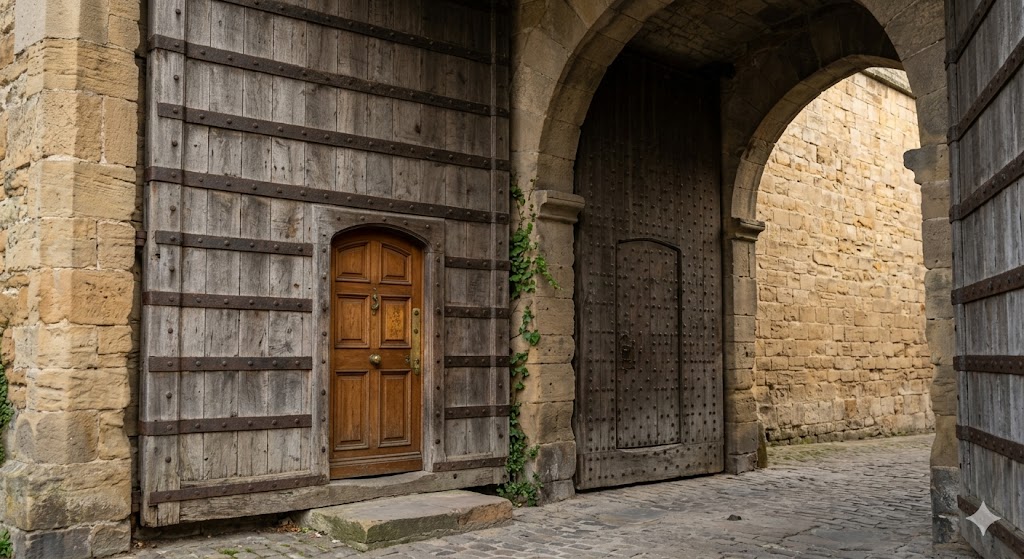
I do not believe AI-assisted development will destroy software engineering. I believe it will change who gets to have a website worth visiting, a small tool worth using, a digital presence worth pointing to. And I think the people who benefit most will be the ones who have always been on the wrong side of the price curve — quietly, without complaint, assuming the door was not for them.
That is the door I want Skill-Wanderer to hold open.
Join the Pilot
If you are a writer or job seeker who needs a clearer online home but does not want a large upfront website project, Skill-Wanderer is testing a quarterly-paid pilot model.
We are taking the first 10 writers and the first 10 job seekers as early partners.
If this sounds useful, reach out at quan.nguyen@skill-wanderer.com and tell me what you do and what kind of online presence you are trying to build. No pitch deck required — a paragraph is enough. I read every one personally.
The pilot is small, and the door is open.