Disclaimer: I am not affiliated with any of the brands or products mentioned in this post, and I do not receive any compensation for the links provided. These links are included solely for your convenience to help you find more information.
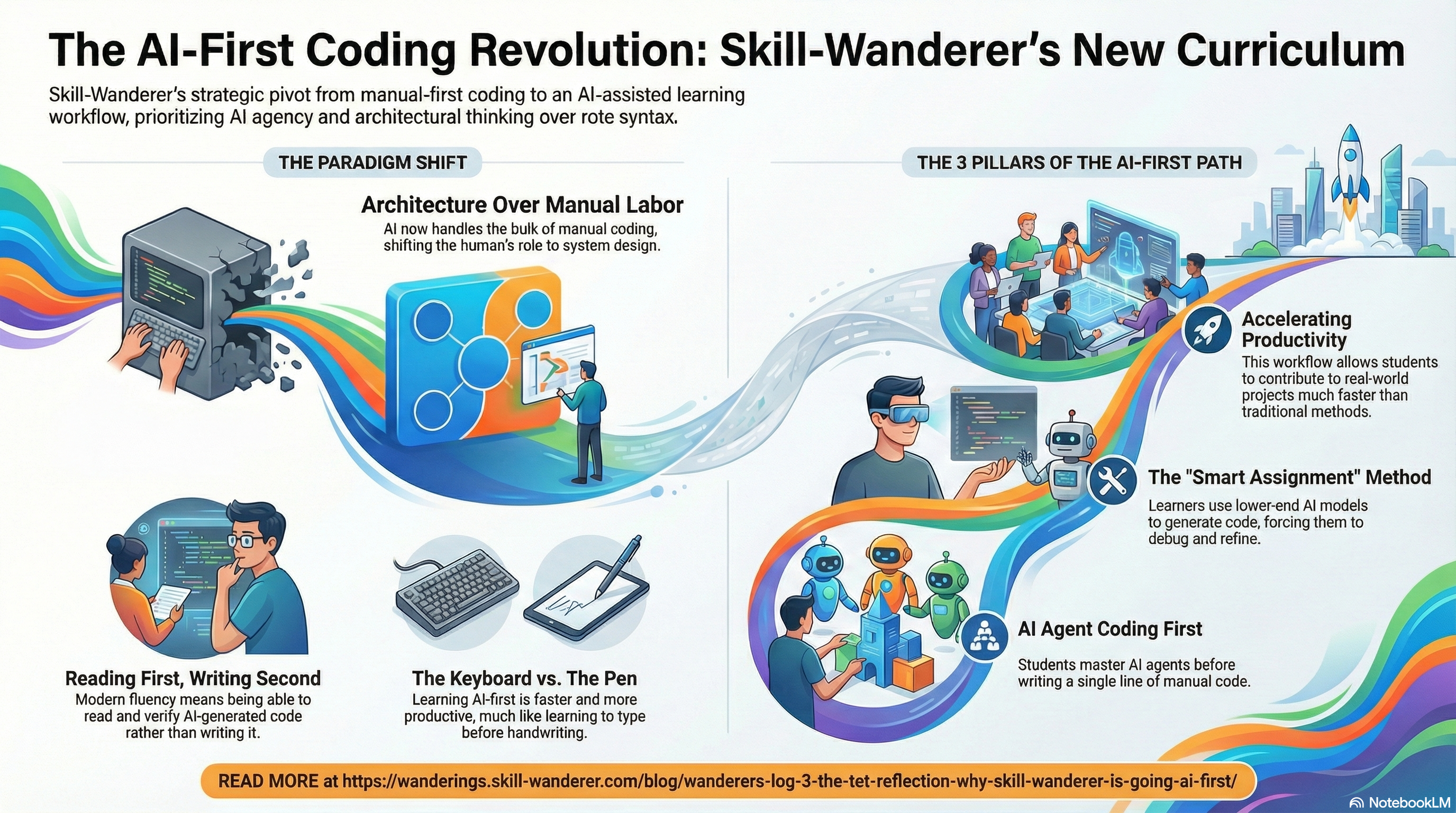
📊 Visual Summary: Want a quick overview? Check out our AI-First Curriculum infographic that highlights the pivot, the three pillars, and the new learning path.
Watch the Video Version or Listen to the Podcast: If you prefer video content, here’s the complete video version of this post:
Or if you prefer audio format, you can listen to the podcast version on Spotify:
📑 Slide Version: Prefer a slide deck? View the presentation below or download the PDF.
🖼️ Infographic: Get a visual overview of the AI-First Curriculum pivot:
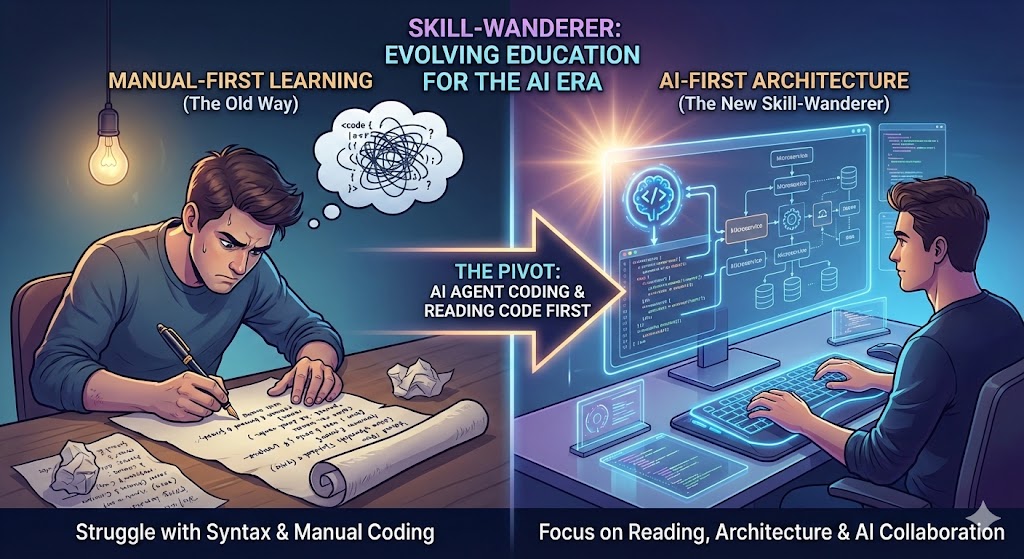
When High Achievers Get a Holiday
Many high achievers don’t truly appreciate holidays and weekends. They want to get their hands dirty, to keep building. But those occasions, when the world slows down, are an invitation for something most of us rarely get: the space for deep work and deep reflection.
This Tết — the Vietnamese Lunar New Year — gave me exactly that. While the rest of the world celebrated, I found myself thinking deeply about how to operate Skill-Wanderer as a non-profit social enterprise. As I’ve transitioned from a charity model to a non-profit social enterprise, there’s been a lot to figure out. The operational side of how Skill-Wanderer runs will be a topic for a future post, but one of the most important realizations that came out of this reflection was about our education methodology — and it demands a pivot.
The Wake-Up Call: Our Curriculum Was Falling Behind
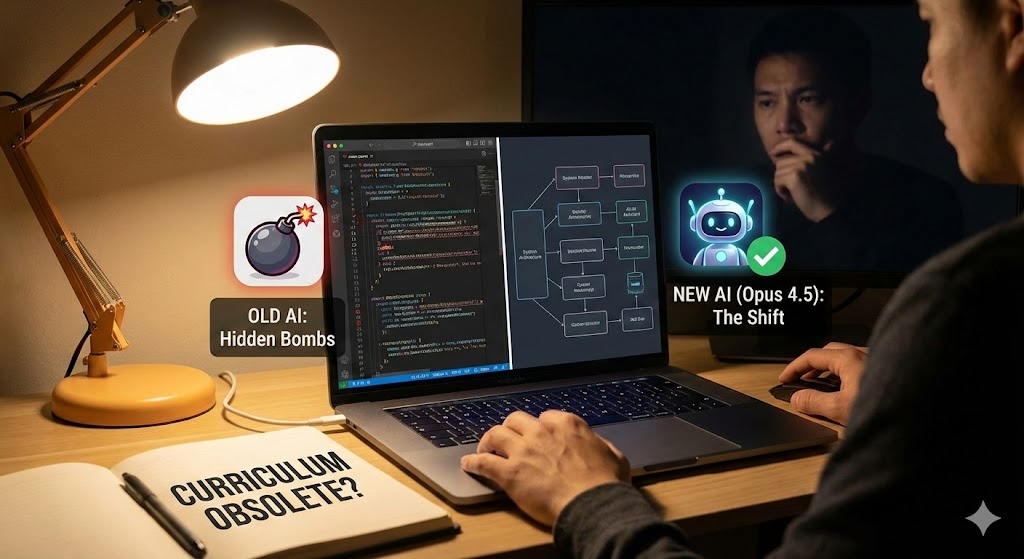
While reviewing our current offerings, I came to a hard conclusion: our tester course is in a reasonable place for now, but our developer course quality was becoming dangerously obsolete.
Here’s why.
Before the arrival of Claude Opus 4.5, and now Opus 4.6, AI-assisted coding always came with hidden bombs. The AI would generate code that looked right on the surface, but underneath, it was riddled with subtle issues — like landmines waiting to go off. As a result, my workflow always included a significant amount of manual coding. The AI was a helper, but you couldn’t trust it to carry the load.
Then Claude Opus 4.5 arrived, and everything shifted. I found that the vast majority of my work had moved to architecture — designing the system, making the high-level decisions — while the AI handled almost all of the manual coding.
No, AI Won’t Replace Software Engineers (Yet)
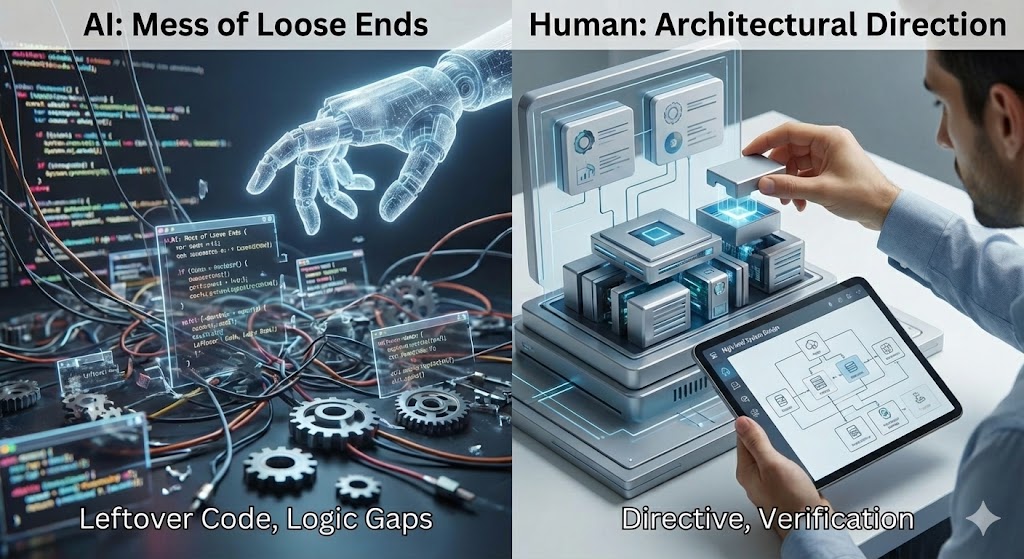
Now, some of you may fear that AI will completely replace software engineers. Based on my real-world experience, that is not true — at least not yet.
I’ve been working with partners, and recently we collaborated on a complex payment feature using Stripe. This is exactly the kind of work where AI falls short. The AI simply did not know how to piece together something this complex and security-sensitive. It left behind a mess of loose ends — leftover code, incomplete integrations, and logic gaps that needed to be cleaned up.
But here’s the critical nuance: no manual coding from scratch was needed. What was needed was programming knowledge, the ability to read and understand syntax, and the architectural thinking to know how the pieces fit together. The AI could write the code; a human needed to direct and verify it.
The Root Problem: Our Curriculum Wasn’t AI-Tool-First

This realization exposed a fundamental flaw in our curriculum. We were teaching learners to write code manually first, and then introducing AI tools as an afterthought. Some of our mentees were struggling to adopt AI-first workflows because the old way of teaching insisted they write every line by hand.
Think of it like this: it’s the equivalent of teaching someone to write on paper before letting them use a keyboard. Yes, there’s value in knowing how to write by hand; you build a certain understanding of the fundamentals. But honestly, I haven’t handwritten anything substantial in so long that I’m not sure I could write neatly anymore. You have a keyboard that can do all the writing now, and teaching someone to use a keyboard is much faster and delivers much more satisfaction than drilling them with pen and paper.
And here’s the key insight: you can always go back and learn the paper-and-pen way later, once you’re already productive with the keyboard. The order of learning matters more than we think.
The Lesson Learned
AI agent coding first, manual coding second. Reading code first, writing code second.
This approach also has a profound secondary benefit: it dramatically accelerates the speed at which learners can start coding and contributing to real projects. Once they’re productive, they can then start tackling higher-order problems like system architecture, design patterns, and security — the things that truly matter and that AI still can’t do on its own.
The Pivot: Skill-Wanderer’s New AI-First Curriculum
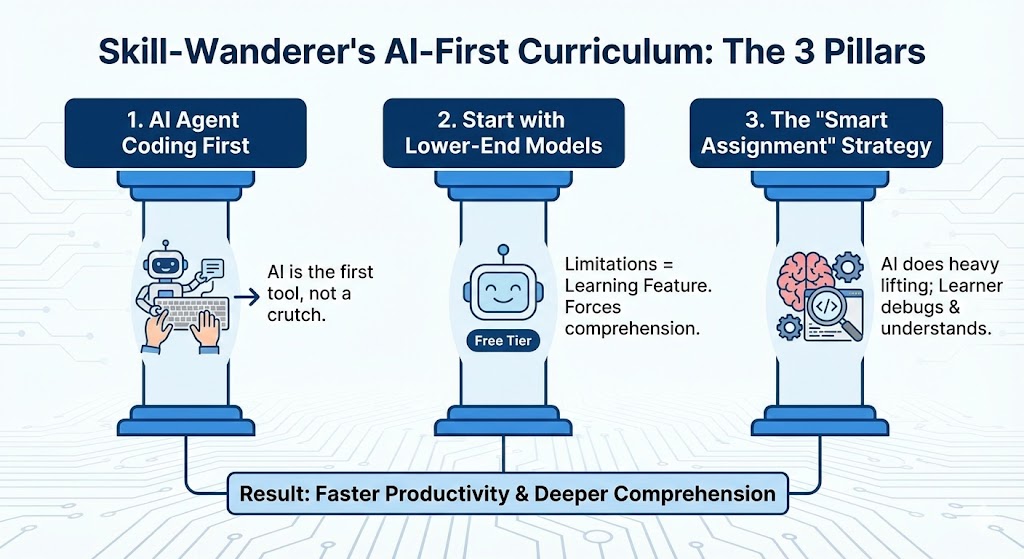
After this reflection, Skill-Wanderer’s curriculum is pivoting. Here are the core changes:
1. AI Agent Coding First
We will make sure every learner knows how to use an AI agent for coding before they write a single line of code manually. The AI agent becomes their first tool, not a crutch they learn about later.
2. Start with Free, Lower-End AI Models
During the learning process, we will ask learners to use lower-end or free AI models — such as the free tier of GitHub Copilot. Why? Because the limitations of a lower-end model are actually a feature for learning.
3. The “Smart Assignment” Strategy
This is where the magic happens. By designing assignments that pair learners with lower-end AI models, we create a learning environment where:
- The AI does the heavy lifting of writing initial code, getting learners productive fast.
- The AI’s imperfections force the learner to read, understand, and clean up the code — developing real comprehension.
- The learner builds a working relationship with AI — learning when to trust it, when to question it, and how to direct it.
And here’s the beautiful payoff: a learner who can work effectively with a lower-end model will be extraordinarily effective with a high-end model like Claude Opus 4.6. They’ll have the code literacy, the debugging instincts, and the architectural awareness to leverage the best tools to their fullest potential.
Looking Ahead
This isn’t just a curriculum update — it’s a fundamental shift in how we think about tech education. The world has changed. AI isn’t coming; it’s here. And the most responsible thing we can do as educators is prepare our learners for the world as it is, not the world as it was.
The Tết holiday gave me the space to see this clearly. Sometimes, stepping away from the keyboard is exactly what you need to figure out the most important thing to type next.
More details on the operational changes to Skill-Wanderer are coming in a future post. For now, the curriculum pivot begins.
See you next time.
Ready to Join the Journey?
If our mission to provide honest, accessible, and free education resonates with you, here’s how you can be part of it:
- 🌐 Visit our platform: skill-wanderer.com
- 📚 Start learning: dojo.skill-wanderer.com
- 📝 Read more: wanderings.skill-wanderer.com
Your journey of a thousand steps starts with a single one. Let’s wander and grow together.